Revisiting Dublin's Dangerous Buildings
A post investigating the fate of Dublin's dangerous buildings
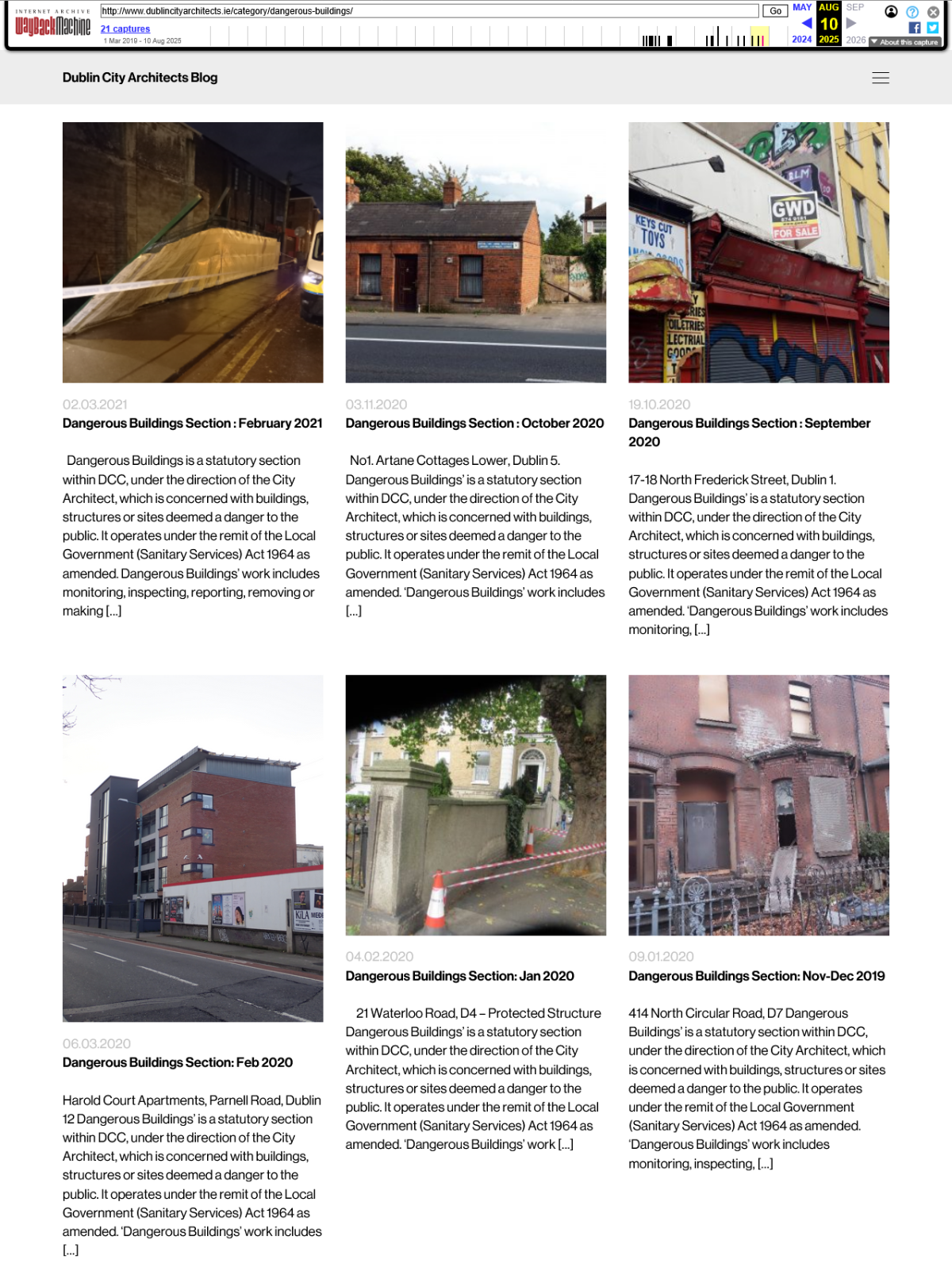
Up until recently Dublin City Architects had their own online blog which included a section dedicated to dangerous buildings in the city. This featured details and images of buildings that had been issued Dangerous Building (DB) Notices by the Dangerous Buildings section in Dublin City Council (DCC):
Dangerous Buildings is a statutory section within DCC, under the direction of the City Architect, which is concerned with buildings, structures or sites deemed a danger to the public. It operates under the remit of the Local Government (Sanitary Services) Act 1964 as amended.
Dangerous Buildings’ work includes monitoring, inspecting, reporting, removing or making safe any building or structure perceived to be a danger within the Dublin City Council area. A team of four DB Inspectors monitor and respond to reports on a day-to-day basis. We do not take action under DB legislation without proper and expert consideration. This will range from undertaking structural engineering surveys and obtaining detailed Conservation Officer advice where appropriate. We will always look to undertake the least invasive works in making a structure safe and only undertake demolition in whole or in part when absolutely necessary. It is also important to emphasise that, under the DB legislation, we cannot undertake remedial works to a property beyond ‘making safe’.
The details provided for each building include its address, the date the DB notice was served, bullet points detailing issues with its condition, and a DB number indicating next steps based on the nature and severity of those issues:
DB Notices are issued to the owners of properties advising necessary remedial action or, as a last resort, taking immediate action to remove danger and making safe. These Notices take the form of:
DB.3 (black) – requires the owner of the property to carry out the described works necessary within 28 days;
DB.2 (green) – requires the owner of the property to carry out the described works necessary within 14 days;
DB.1 (red) – enables the DB Inspector to access the site with the necessary equipment and personnel to immediately make safe and eliminate danger at the property or structure.
DCC DB will look to recoup any costs associated with the works from the owner on completion. Following on from the 2016 and 2017 series of notices.
Finally, the site was also notable for including images for some of the buildings which visualised their condition.
My own interest in the site was as a source of material for a spoof property website I’ve been working on with other members of the Data Stories team. The basic premise was to satirise the property market in Dublin by advertising derelict and vacant buildings for sale and rent.
That project hasn’t been released yet. However, returning to the material after the Christmas break I found that the Dublin City Architect’s website was no longer online. I can’t tell exactly when the site was taken down. However, a copy of the site from 10/08/2025 is still indexed on the Internet Archive’s Wayback Machine: https://web.archive.org/web/20250810011251/http://www.dublincityarchitects.ie/category/dangerous-buildings/
The last updates to the Dangerous Buildings section of the Dublin City Architects website date back to March 2021. In the years that have passed since, it is likely that many of these properties may have been renovated and resold on the property market. Any residential properties amongst them should appear on the Residential Property Price Register that is maintained by the Property Services Regulatory Authority (PSRA).
The intended aim for the Dublin City Architect’s site was ‘promoting design and providing architectural, urban and conservation design services to Dublin City Council’. However, one can also speculate whether it might also inadvertently served to highlight future real-estate opportunities in the city. In the coming weeks I’m keen to investigate further and find out what’s become of these dangerous buildings.